AI Pono
Purple Maiʻa's A.I. Pono Educator cohort reframes AI in education from efficiency and policing to empowerment and agency. The program helps educators understand AI as a power system shaped by data, values, and human decisions. The December 2025 cohort equipped 10 teachers and 300+ students from 5 schools to build machine learning models, shifting from passive consumers to active builders. Rooted in ʻai pono—consuming and creating responsibly—it challenges participants to question who builds AI, whose data trains it, and who benefits.
When we ask teachers what they think about AI, many describe it as a supposed solution to their exhaustion, a tool that can grade faster, generate lesson plans, and help them keep up with impossible demands. At the same time, they feel conflicted about whether they want students using it.
School leaders are eager to bring AI-literacy into their schools, yet are simultaneously scrambling to respond to the growing concern around AI “cheating,” a phenomenon that frustrates teachers and adds to their workload. As a result, teachers feel increasing pressure to serve as AI enforcers in addition to being counselors, mentors, tutors, and guides. Somewhere along the way, the conversation about AI in education has become centered on efficiency, fear, and compliance.
Our Kula team knows that this conversation is incomplete.
More efficient lesson plans are not going to transform pedagogy. Faster grading is not going to address inequity. And banning or policing AI use will not prepare young people for a future where these tools are embedded into nearly every system they will encounter. We are focused on answering a different question: What if all of this noise is actually distracting us from something much bigger that is happening?
In our communities in Hawaiʻi, the rise of AI is not just a classroom issue, it is a question of who holds power in society. Our communities have yet to be equitably represented in AI development, yet we are deeply entangled in its impacts. Most of our relationship with AI today is as users and consumers, paying subscriptions, and feeding systems that grow wealth and influence far beyond our communities. It mirrors older patterns of resource extraction, only now the resource is data, culture, and knowledge. Some have begun calling this moment ʻtechnofeudalism’. We see it as an invitation to rethink what education is preparing our students and teachers to do.
As technology educators, we feel responsible for not just teaching people how to ethically use tools, but to help them understand how tools work, and how they might have the power to reshape them. That means shifting away from fear-based narratives and quick fixes, and toward deep learning that builds agency, confidence and critical awareness. It means teaching AI not as magic, but as something made by humans, trained on data, shaped by values, and therefore open to critique and reimagining.
This is how our A.I. Pono Educator cohort was born. We designed it not as a training on the latest AI tools, but as a space for educators to slow down, ask hard questions, and reconnect with their own power. Instead of asking how AI can make our work faster, we began asking who is building these systems and tools, whose data is being used, and who gets to decide how that data is monetized. Most importantly, we asked what it would look like for educators and students to move from being buyers of AI to builders, stewards, and decision-makers.
One educator shared, “ʻAi pono is not just about food. It is anything you consume. And once you consume something and let it sit in your mind, spirit, and soul, there is an expected regurgitation, like a mom chewing up the maiʻa and spitting it out into their baby’s mouth. So if we are consuming data, we have to think about what kind of decisions are being made based on that data and whether it reflects where we are from and the values we hold.”
Another educator shared, “If you are ʻono for something, then you need to learn how to make it.”
These statements capture the spirit of AI pono as something not centered on consumption, but on empowerment — the ability to create and to feed. We peeled back the curtain on AI tools and equipped education leaders with a foundational understanding of how machine learning models are developed, enabling them to guide students beyond passive use and toward agency, creativity, and critical thinking.
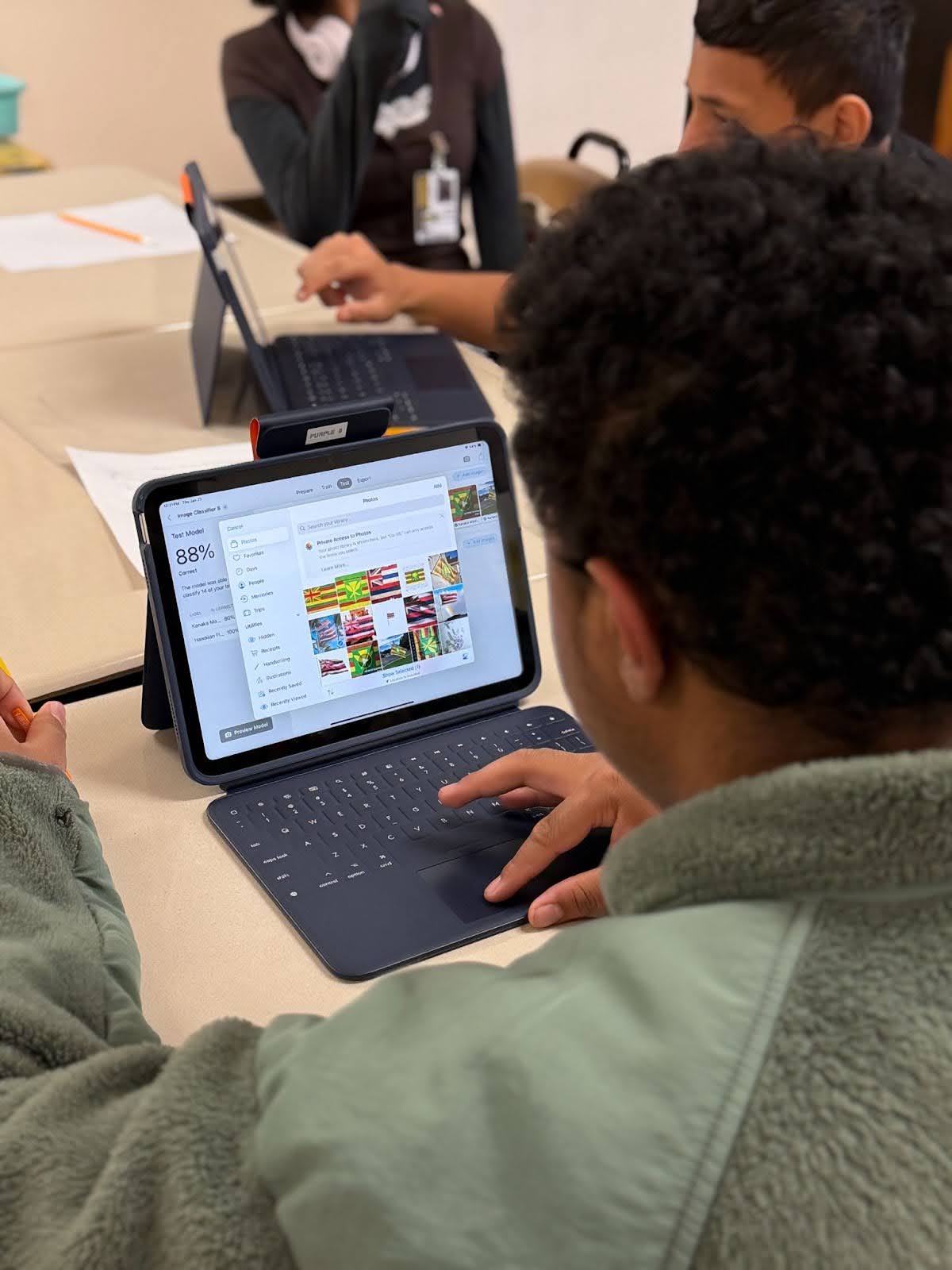
As a result of this inaugural cohort, which we put on in December 2025 through a hybrid format, 10 kumu and 300+ haumana from 5 schools were able to see themselves as engineers. They built image classification models with machine learning, and explored the challenges and joys of data collection. They learned the difference between training and testing data, and quickly realized the deep importance of diversity and collaboration in order to produce the highest quality data sets, and in turn the highest quality models.
Our first A.I. Pono cohort created a shared moment in education in Hawaiʻi that we hope will ripple outward as educators continue to carry this work into their classrooms and students begin to imagine themselves differently in relationship to technology. This is just the beginning.