Building the Builders
Inside ʻĀina Foundry, Purple Maiʻa's bold new program to grow Hawaiʻi's next generation of technologists — and build the tools to prove it can be done.
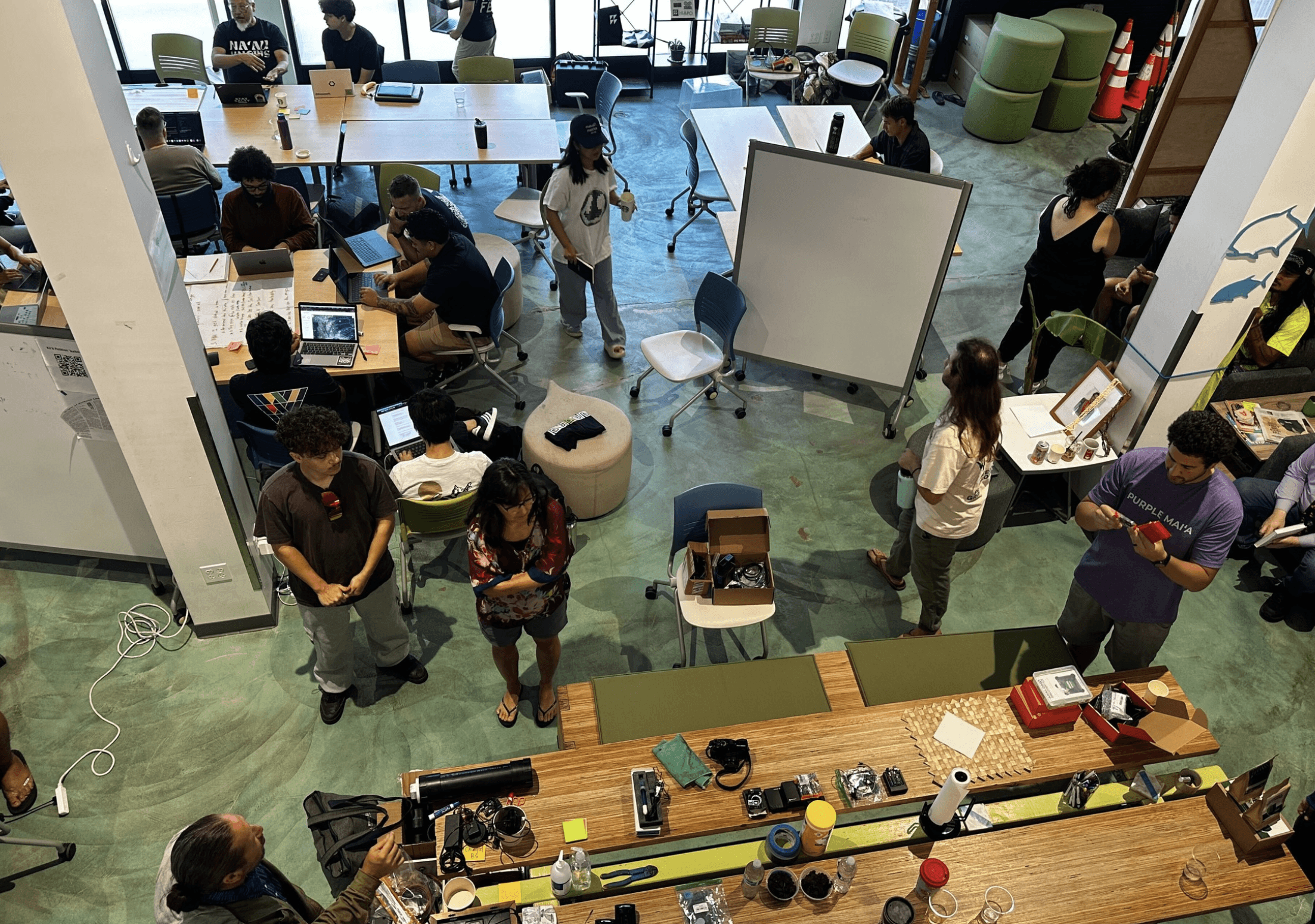
Something has shifted at Purple Maiʻa. After more than a decade of teaching kids to code as a Hawaiʻi-based tech nonprofit, we’ve made a daring pivot: it's not just training builders anymore. It's becoming one.
ʻĀina Foundry is the program at the center of that shift — part software studio, part talent incubator, all rooted in a conviction that Hawaiʻi doesn't just need more tech workers. It needs builders who create value on their own terms, in their own community.
I sat down with co-founder and co-CEO Donavan Kealoha and ʻĀina Foundry's David Pickett and Joe Baranowski to talk about what it means to build, why certifications aren't the answer, and what AI is doing to the very idea of an entry-level job.
EVOLUTION OR REVOLUTION?
ʻĀina Foundry is, on its surface, a natural extension of Purple Maiʻa's decade-long mission. But it also represents something meaningfully new: a deliberate decision to stop just preparing people for the tech economy and start shaping it directly.
Donavan Kealoha
We've always been opportunistic — people came to us with ideas or funding, we tried things, and we could always find an educational hook. But after our ten-year strategic retreat, we asked ourselves: are we primarily an education organization, or do we aspire to do more? We're positioned uniquely in this ecosystem. We are likely the organization in Hawaiʻi doing these tech things, grounded in a Hawaiian worldview and oriented towards serving ʻāina, the lāhui, and the larger community. So ʻĀina Foundry is partly about bringing two worlds together — high-tech, fast-moving economic opportunity, but for a larger group of people than just founders and investors.
David Pickett
We've always looked for the 'purpleness' in the people we hire and the students we work with. ʻĀina Foundry is about systematizing that — taking what we've seen work across our programs and building a more intentional pipeline. The part that feels genuinely new is the focus on scalable companies. We've always had that in the background, but we've never built a whole system around it.
“Nobody’s going to save us. We’ve got to go save ourselves — and to do that, we’ve got to go build things that create value.”
Donavan Kealoha
The name came out of a joke because of the initials — but what it means is serious. ʻĀina is in front of the word Foundry because it anchors the work. It's not the AI Foundry or the hardware foundry. It's the ʻĀina Foundry. That tells you what it's supposed to be doing. And then, just as important is that : we've got to build stuff. Nobody's going to save us. We've got to go save ourselves.
WHAT IS A BUILDER?
The word 'builder' is everywhere right now — from tech boardrooms to startup pitch decks to, apparently, billboards in San Francisco. But Purple Maiʻa is using it to mean something specific.
Donavan Kealoha
A builder isn't necessarily someone slinging code, though that's part of it. It's about making ideas real, tangible, usable. You take something and you create something that people interact with.
Joe Baranowski
It's creative problem solving, put into practice. Not just theory. The mindset is: let's go make something. If it's not good enough, we'll figure out how to improve it or start over — but we'll learn along the way. We're trying to instill that curiosity in our interns. There's no roadmap for most of the hard stuff. Maybe 80% of it you can figure out. The question is how you get that last 20% to tie together into something usable.
David Pickett
You don't want to just observe, and you don't want to just talk about what could be. Our operating principle is that if you're actually trying things and putting things together, you gather feedback faster and solve problems more effectively. The 'ideal builder' we talked about with our board is someone who can design, hack at a low level, sell to customers, start their own company, and still be community-focused and culturally rooted. Most people aren't a ten out of ten on all of that — and that's okay. That's why we build teams.
WHY NOT CERTIFICATIONS?
For years, workforce development in tech has been dominated by one question: what credentials do employers recognize? Purple Maiʻa is betting that's the wrong question — especially now.
Joe Baranowski
With AI moving as fast as it is, a certification can be out of date before you've finished earning it. It might not buy you anything. We'd rather focus on application — actually building a product, learning the process, developing a portfolio. The ongoing question is: how do we help people show their experience and find opportunities when they're done?
David Pickett
In my entire career in custom software development, I never once heard anyone care about a certification — except in the Salesforce world or IT networking. And the direction things are moving, with AI tools improving so fast, I think it pushes toward generalism. You need someone who can learn tools quickly, work with community, figure out what the right problem is, and then actually make the thing. Certifications tend to be narrow and go stale fast.
Donavan Kealoha
We ran a Salesforce certification program. It worked — but the job market in Hawaiʻi for that specific credential has limits. What we're trying to build or help shape now is a person–a well-rounded, scrappy, creative problem-solver who can demonstrate value in lots of different contexts.
THE AI QUESTION
No conversation about building software in 2025 can avoid the subject of artificial intelligence — particularly what it means for junior developers whose entry points into the field are narrowing.
David Pickett
For certain kinds of projects — a pilot, a prototype, something that's been reasonably well spec'd out — I would almost call development time free right now. An AI can knock out the first version while you focus on working with the customer and testing. That's exciting, but it also raises hard questions. One of our interns, Jaden — a junior developer — asked us directly: given all this, where should my career go?
My suggestion was to think about what skill set would make you a solo founder with outsized impact. How do you learn enough about design, sales, and product that you can work alongside AI and direct it well? How do you develop the taste to know when what it's producing is good or not? Because AI can spit out a UI — but it often looks like every other AI UI. Knowing the difference matters.
“We just need to teach people how to solve problems and have grit. Build stuff. What did you learn? How can we make it better?”
Joe Baranowski
A year ago I was thinking we needed to prioritize technical skills above everything. Now I think it's simpler: we need to teach people how to solve problems and develop grit. Build stuff. What did you learn? How can we make it better? How do you work with an AI that keeps making the same mistake — can you adjust the prompt, add a rule set, make it perform better? That's the skill.
Donavan Kealoha
There will always be opportunities for people who can demonstrate value. The kids who are pinging me about AI agents, who are showing me things they've built — those doors never close. But if you're waiting to be handed a discrete task, that market is harder now. The tools have changed fast. We did a hackathon not even a year ago and those AI-assisted builds were pretty rough. The same tools today are unrecognizable. We have to take advantage of that.
WHY DO BOTH AT ONCE?
Running a software studio and a talent incubator simultaneously is, by any measure, harder than doing one or the other. So why does Purple Maiʻa insist on both?
Joe Baranowski
Beyond the people I get to work with every day — I think we're making a difference. We're giving interns a leg up. And the big goal is building companies in Hawaiʻi that can eventually hire those same interns. That's the flywheel.
David Pickett
Practically speaking, organizations need young people's ideas to not go stagnant. The way someone who grew up with today's tools approaches a problem is genuinely different — and often better. You need to bring new people into the network in order to find the right problems and get the right people working on them. Not only is it the right thing to do; I think it's the needed thing to do.
ʻĀina Foundry is an initiative of Purple Maiʻa Foundation, based in Hawaiʻi. Learn more at purplemaia.org.