Designing From Place
The story of Purple Maiʻa's Mōhala department and its Digital Creators program, which teaches design, marketing, and storytelling from a culturally grounded Hawaiian perspective. The program emphasizes the importance of understanding cultural context in design work and helping community organizations document their impact to secure funding.
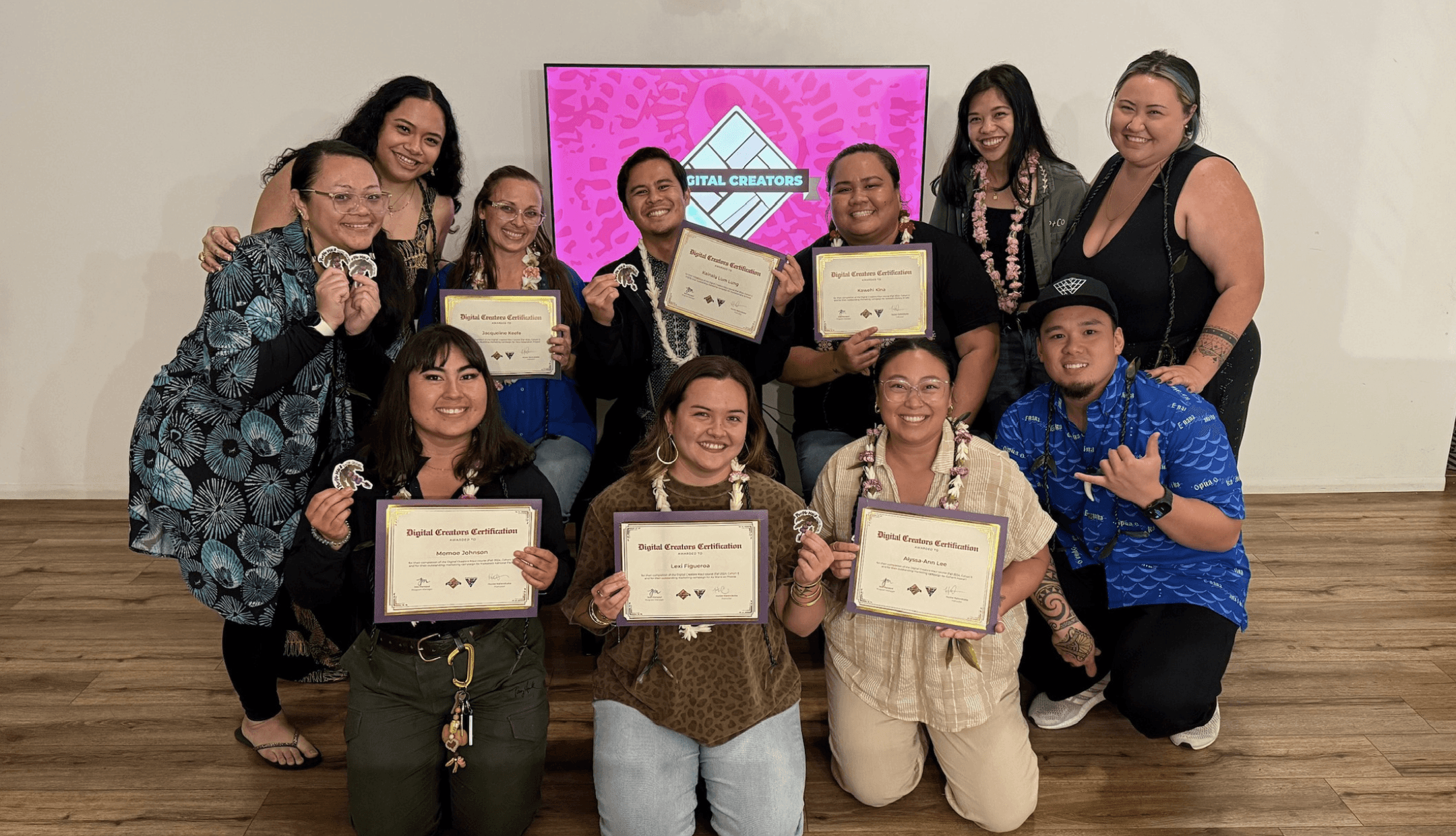
Mōhala means to bloom, to flourish, to open up. It is a word that carries patience in it, the understanding that growth cannot be forced, only cultivated. For Purple Maiʻa's Mōhala department, it is less a label than a philosophy, one that shows up in everything from how they run a classroom to how they think about the future of Hawaiʻi.
The department grew out of a period of organizational change, when a handful of programs that did not quite fit anywhere else found each other and realized they shared a common root. The focus of each was different, but the underlying goal was the same: to help people bloom, grow, and come into their own. The name followed naturally.
At the center of Mōhala's community-facing work was Digital Creators, or DC, an introductory program in design, marketing, and storytelling led by Makana Waikiki, director of Mōhala, alongside team members Tre Zamora and Hunter Nahoʻoikaika. Six cohorts of alumni later, the question the team keeps getting asked is: when can we come back?
"Every student that we've worked with has been able to say, I am a digital creator, and I know what I'm doing," says Waikiki. "And we still have relationships with them. We still have pilina with them."
The word pilina comes up often in conversations with the DC team. Relationship. Connection. It is, by their own accounting, the most important outcome the program produces, and the hardest one to put in a grant report. Confidence runs a close second. DC was built on the premise that there are people across Hawaiʻi who have something to say and the instinct to say it creatively, but who have never been given a room that told them they belonged there. For each member of the team, that premise is personal.
Waikiki describes Purple Maiʻa as the first space where she felt genuinely believed in, where her knowledge was not questioned because of her age or gender or because Hawaiian was her first language. Teaching, she says, was something she never expected to find herself doing, and then discovered was one of the great joys of her life. Nahoʻoikaika came to the team after years of working as a brand designer, searching for a creative grounding she had not found elsewhere in Hawaiʻi. "I can be in these tech spaces," she says, "but I stand in the creative space." For Zamora, Mōhala became a place to articulate something he had long felt: that design and storytelling in Hawaiʻi carry a specific responsibility, and that responsibility deserves its own room too.
DC was built to offer participants that same sense of grounding. You can learn the mechanics of graphic design or social media marketing anywhere. A Google course or a university program will give you the fundamentals. What those resources cannot offer is context. There is a culturally specific way to approach design and storytelling in Hawaiʻi, Zamora explains, and navigating it is its own ongoing practice. "We teach these fundamental things while exploring from a culturally grounded perspective and approach, for and in the context of Hawaiʻi," he says. For many participants, the response was simply: "Oh, that's a thing. I didn't know that was a thing."
It is, in fact, a thing, and the team speaks about it with the kind of specificity that comes from having worked through it themselves. Being a Kanaka designer or storyteller in Hawaiʻi means moving between worlds, Zamora explains, constantly negotiating between what clients want, what feels pono, and what the community will receive. "It's a constant battle of inner turmoil, of what's right, what's wrong, what is considered right, what is considered wrong, and to who, and for what context." DC did not resolve that tension for participants, but it gave them a framework for navigating it. "The value and the importance of it is not to say that we are the people to say this is what to do and this is what not to do, but to give you additional context and guidance from our personal perspectives, from what we've been through and lived experiences."
Nahoʻoikaika, who has spent years navigating that tension as a brand designer, puts a finer point on it. In logo design especially, she explains, you are not just making something look good. You are shaping what other people believe. "You are influencing what other people see. It's a form of communication." The market in Hawaiʻi is more saturated than it has ever been, she says. In many ways, it’s a beautiful thing—more designers, more businesses, more stories being told. But it also means more opportunities for imagery to be used without understanding, for the word "Hawaiian" to be applied loosely, for symbols to be flattened into aesthetics. "There's a lot of meaning behind it, and it's really important because it can get misconstrued a lot of the time." Her advice: don't do it alone. "Talk to community, talk to other people. I think that's what our people was really good at."
The team carried that same instinct into their community partnerships. Zamora describes the pattern they kept encountering: nonprofits doing vital, sustained work with no one on their team whose job it was to document or communicate it. The DC team found themselves not just training participants but stepping in to help organizations tell their own stories. One community partner had more than three generations of work behind them. When they applied for a grant, they were denied. They had not, the reviewers said, demonstrated enough community impact. They had been doing the work for half a century. What they had not done was document it in a way the outside world could read. With support from the team, they rebuilt their story, reapplied, and got funded. "It was essentially miscommunication that led to a lack of funding," says Waikiki, "which happens so often, especially in outer island community nonprofits." They are hana people, she adds. They are in the ʻāina, doing the work. Stopping to make the video is not the priority, and it should not have to be.
This is where the stakes become historical. "Without that base concept of we have an interconnected responsibility to each other and to this ʻāina," says Waikiki, "what comes out could be very harmful to people, or could just completely miss the mark." Western frameworks for marketing and storytelling were not built by the people of this place or for it. In Hawaiʻi, they carry a particular weight. "We were almost erased," Waikiki says. "Our culture, our language, our practices. They used marketing and propaganda to colonize Hawaiʻi. It changed narratives, shifted perspectives of entire populations." The tools of design and storytelling have been used against our communities before. The renaissance kuleana, as she frames it, is to pick up those same tools and turn them around. "When everyone is equipped with tools, when everyone is equipped with a kahua and a foundation that at least gives you the basics, then we're moving as a unit versus as one individual trying to fix an entire system."
That, the team would argue, is the real work. Not any one program, not any one cohort, but the slow accumulation of people who know what they are doing and why it matters.