“I wanted to create”
A conversation with ʻĀina Foundry Apprentice Jaden Kapali
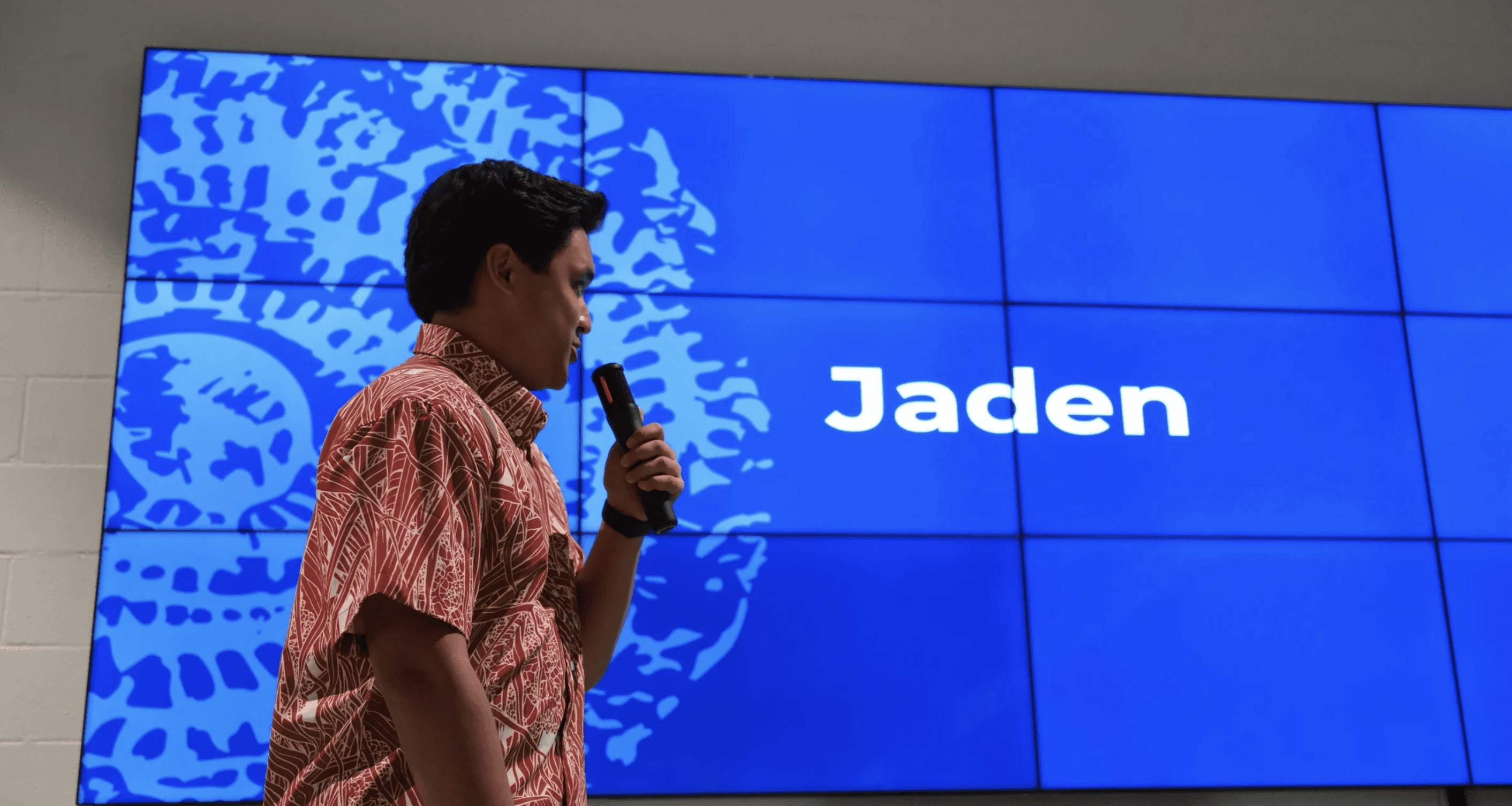
Date: Feb 4
Kelsey: Today we have Jaden Kapali, our first apprentice in our new program, the ʻĀina Foundry. We want to hear your story. I’ll start by asking you. Who are you?
Jaden: My name is Jaden Kapali, I call Kapaʻa Kauaʻi and Hilo Hawaiʻi my home. I moved in between those places when I grew up. Went to Kamehameha Schools, Native Hawaiian. I went to UH Hilo for computer science, and also a number of certificates: creative writing, digital visualization, art minor. I guess my community is just the Native Hawaiian community and the tech community as well. There's a weird gap in between, and I'm trying to figure out a way to kind of blend the two, and that’s what Purple Maiʻa is doing.
We moved to Kauaʻi because my dad got a job as IT Manager on Kauai for that island district. Both my parents were teachers, but my dad was the main tech guy who inspired my techiness. I grew up patching cables, doing all that stuff. Replacing routers. It was kind of my inspiration to do the computer science degree because that's what he did at UH too.
Kelsey: How did you get connected to us at Purple Maiʻa?
Jaden: At UH Hilo I was looking for internships. My girlfriend, who worked for the Kīpuka Native Hawaiian Student Center, they were having a whole Kāpili ʻOihana event. That's a KS program. And I knew about Purple Maiʻa for a while because one of my aunties slash advisors talked to me about it right when I first started college. Because she was like, oh, you’re doing computer science and you’re Native Hawaiian. Look at this company Purple Maiʻa, because they're really cool. When I saw your name on the Kāpili ʻOihana dashboard, I was like huh, I'll give it a shot, see what happens.
And then I submitted–not technical things because it asked for creative things like, art, visualizations. So I submitted, like, I worked as the layout designer for the school newspaper, so that. I worked on a VR game. I showed that. Keoni was my interviewer. And he was like, hold up. I saw your resume. Can we talk more about, like, your AI stuff, your web scraping, all that stuff. Okay, sure. I expected interning for Purple Maiʻa as, like, creative assistant. But then I ended up doing, like, a whole database management with the Kūʻē petition.
I was trying to be a rebel in college. “I don't want to do computer science. All my family wants me to do it, so I'm gonna do art.” Stuff like that. But I do love the arts. I like to have a creative outlet. But in this new world I'm glad that it ended up with computer science and being a developer. Because it's a solid career. I would like opportunities to get back into the arts. I think it's like a balance, too, with art and computer science. Software development is an art, I would say.
Kelsey: So you worked on the Kūʻē petition project for a while and eventually did an internship when we were very early piloting the internships for ʻĀina Foundry. And then you came on full time as our first apprentice. What is it that you are doing now? What's your role? What projects have you been working on?
Jaden: When I first came on, I was working on the KILO dashboard, which is what I worked on during the internship as well. It's an environmental monitoring dashboard. And then I worked on the Food+ bill scraper, it’s a dashboard to track bills without the manual things of going to the Hawaiʻi capitol website. So I made a scraper, helped Janine build that out. She vibe coded that initial prototype. I helped build it out properly. And then I worked on Makaliʻi Metrics’s dashboard as part of the whole team with Joe and David. At this moment, I’m working more on the hardware side, figuring out how to get Raspberry Pis to a local farm and hosting applications on that. How to get a database on there, how to get AI or LLMs hosted on there.
Kelsey: Why work at Purple Maiʻa? Why not somewhere else in tech locally or trying to go to the mainland?
Jaden: After graduation, I already interned for you guys, but I was looking at the job market locally in Hawaiʻi for software developers. It was like, little to none or you need like 5 years experience. And that was very hard to swallow. And especially with AI coming in, the junior developer role is kind of going down. Like, opportunities for that is going down. It was a weird position because I wanted to stay in Hawaiʻi. I did not want to go to the mainland because I knew a lot of stories, and it's a norm, right? People go to the mainland from Hawaiʻi. They go for, you know, priced out of paradise. But they end up never coming back. And they always want to come back, but they can’t. And I always thought if I work hard to stay here, then I will stay here.
Fixing and developing. My dad was a fixer. He was an IT Manager. I would shadow him all the time. I did not like it [laughs]. I guess it was kind of boring just to fix people's problems. I wanted to create. Even as a young kid, I liked to create, whether it be Legos or art or anything like that. And I thought software development was kind of like my blend of both, two of my brains. The technical problem solving and the artistic creative side. That's why I wanted to be in software development. And there’s not a lot of that in Hawaiʻi. It's really not a lot of opportunities there. Because everybody needs someone to manage something in tech or to fix something in tech.
The tech and innovation sector in Hawaiʻi is kind of small in my eyes. Unless I haven't been exposed to it a lot, being from Hilo and being from Kapaʻa. Especially in those regions, software development is not available. Maybe I will go to town in Oʻahu, but it's not my jam. So basically, job market is bad.
Kelsey: What else do you want to say about your story?
Jaden: Right now we're in a lot of talks about AI, sovereign AI and data sovereignty, and that's kind of a big push on my end. Because of the moral aspect too. Being a Native Hawaiian and trying to advocate for sovereignty. It's kind of the thing that we need now. And we have these tools to push it forward, but we don't have enough people to do it. What I guess I’m trying to say is, there's steps to complete sovereignty for Hawaiians. We have to fit within this political field. But using AI, using these technological tools, we can amplify it in a way that we can get to a place where we feel sovereign. Because Brandon from Nation [of Hawaiʻi], what he said to me a lot was, we cannot wait for someone for sovereignty. You have to advocate for your own. A lot of people don't know how to do that. How do you advocate for your own? So I like to try to figure out how to make tools using technology.
My ambition or that driving factor, my influence, to why I do technology in Hawaiʻi was King Kalākaua. He was the first to bring electricity, and that was like a foreign technology. And I believe that we, bringing AI into this space, we can be like that and innovate ourselves to be a stronger people. That's my analogy. If King Kalākaua did it why can’t we? If we can get our AI sovereign, our data sovereign, then we can get our food sovereign, we can get our economy sovereign, be our own community. I know how to do tech, and that's where I'm going to stand. I think there's a lot of pathways for it, especially in today's world.
I do want to say mahalo for allowing me to have the space to say my story. And I hope my story helps with anything you guys need. And for future apprentices, don't be afraid of the dark. We live in the dark. We were born in the pō, I would say. In the Kumulipo we were born in the pō. So don’t be afraid, go in there. That's it.