Piko, Passion, Purpose
A conversation with Mike Sarmiento, Purple Maiʻa's VP of Education, about the Future Ancestors program and its philosophy centered on three concepts: Piko, Passion, Purpose. The discussion covers how Future Ancestors expanded from 20 students in Waiʻanae to 300+ students across four islands with 30+ teachers. Mike explains the community-based approach, the importance of safe spaces for teachers, and how the framework empowers educators to adapt it locally rather than follow a rigid curriculum. The post also examines how this extends into professional development through relationship-building and cohorts like Paʻa Moʻolelo, creating a network of educators integrating these values into their practice.
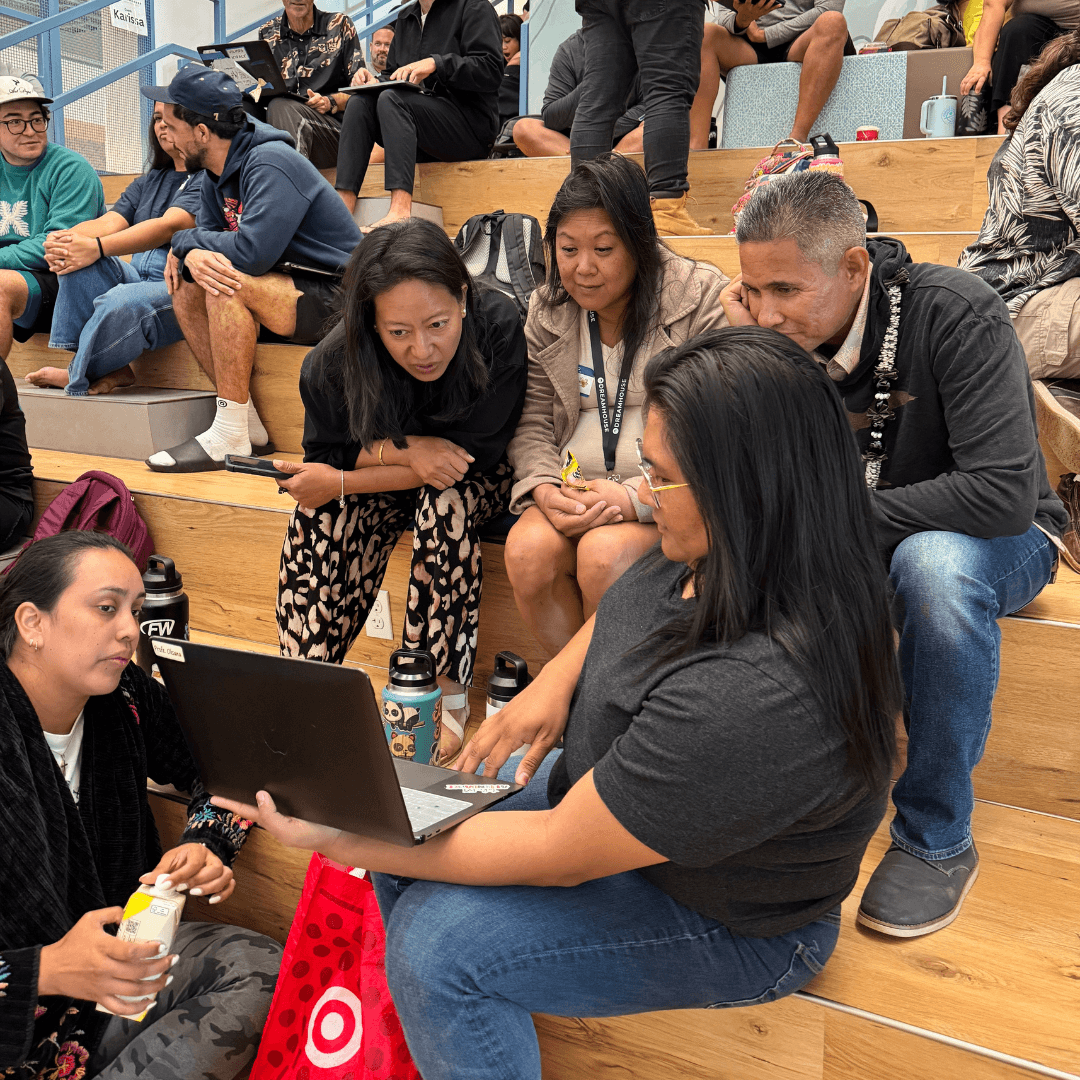
A conversation with VP of Education Mike Sarmiento about future ancestors, empowering teachers, and the purpose of education
Mike: When I started at Purple Maiʻa I thought about, how would young Mike as a kid, be connected to Purple Maiʻa? What would I want to do? And it wouldn't be the coding classes, but it would be classes that worked on my passion. And then maybe it snuck in the back door and introduced me to how technology is relevant to the things that I care about. That was the idea for Future Ancestors, and what that led to is this idea of piko, passion and purpose.
Piko speaks to this idea of being connected to where you come from, who you are, to our ancestors and the people that have come before us.
Passion is really about, what do you love? What are the things that you want to amplify? Because those are the things that are going to pull kids in rather than like, hey, what kind of job do you want? I think most kids not really thinking about that at 9, 10 years old; they really just want to be in the ocean or they want to be exploring
Then as you start to explore your passions, how does that drive your Purpose? How can that be connected to your community and to other people, and how do we start to work in some of those values?
It's kind of this approach of looking at yourself as a whole person, as a whole future ancestor, somebody who's honoring their past and somebody who's thinking about the future, and then, at the same time, they're very much alive and living in this present.
Kelsey: Future Ancestors is very community based and very much about place. Can you talk about that?
Mike: Yeah. Communities have stories. And sometimes those stories aren't written by the community, they're written for the community. And if you're told that story enough, you start to believe those stories from other people. The way we thought about Future Ancestors is to start with the richness of your own community. What are the things that are valuable? Waiwai is this idea of what is valuable. And oftentimes it's tied to water, but waiwai can be lots of different things. We’re giving kids a chance to understand their community is wai and that there are people and places in their community that are waiwai.
The hypothesis is if you start to understand the value of your community, then you start to understand the value of yourself, your family and the people around you. If you start there, you have a foundation to then step out of your community with confidence and go learn about other people’s communities.
One of the big aspects of Future Ancestors is the different huis visit each other. Once the kids understand the richness of their community they’re prepared to host another hui from a different community. It’s an opportunity for young people to share with each other, which often is like, that's a barrier a lot of times within communities that we're often pitted against each other.
Teachers need safe spaces to hone their practice
Kelsey: 2025 was the biggest year yet of Future Ancestors programming. What has it been like from the beginning to the biggest year yet?
Mike: Starting in Waiʻanae was important to me, especially being from Waiʻanae. We started at Ka Waihona, which was a school that I was working at and still had connection to. We started with a little over 20 kids. The idea was not just for me to run the program by myself, but to think, who's best suited to be running a program like Future Ancestors and helping to design it? Teachers are the best at recruiting kids, the best at knowing their community, they already have connections. So that was the hypothesis: let's bring a hui of three teachers, pay them part time, and work on it together.
If a teacher can teach during the summer doing things that they actually enjoy doing, then they don't have to get a job driving an Uber or doing these other things. They can actually hone in on their practice. If we want culture based education, if we want technology innovation education, then we have to give teachers an opportunity to practice in a safe place. We started with asking teachers, who are the kids that you'd want to work with? Who are the kids that you think would benefit from this? It’s these components that I think make Future Ancestors work.
Each year it's grown. This past summer we went to 13 different locations, over 30 kumu, over 300 students on four different islands, including Lānaʻi, Big Island, Kauaʻi and Oʻahu. That kind of growth has been really cool because it means our framework of piko, passion, purpose really speaks to teachers who understand culture-based, community-based education, and it makes them excited. What we try to build is a framework that gives them a direction, but not a curriculum that tells them what to do. We're not telling the communities, this is how you should teach this. We're really giving the teachers an opportunity to define for themselves this idea of Future Ancestor with some parameters and then go out and try it.
The hope would be ultimately that teachers learn how to teach like this during summer, and some of that ʻike, some of that framework starts to seep into your regular practice as a teacher during the school year. And then into your school environment. And if you have multiple teachers doing that now, you can start to get some momentum to push things forward as a school.
Kelsey: What an interesting way to scale. It’s not packaging something and copying it and taking it far and wide. It’s more like empowering individual people to do it their way in different places and in different communities.
In the last few years Kula has gotten into education for teachers as well. Can you talk about how Future Ancestors lines up with “Pilina development” and what that is?
Mike: I’ve been a teacher in school. I hated professional development. Most teachers that you talk to cannot stand professional development because it's often very disconnected. So we thought about how can PD be different? It starts with relationship. If I'm going to take up your time, which is precious for anybody, but especially for teachers, then I should be working on building a relationship so that you understand my perspective and why I'm there, and I better understand your perspective and what you want to do.
Before I can tell you anything about any of these technologies or whatever, we're going to start in a grounding of who we each are as future ancestors. And so we go through a process of talking about the values of a future ancestor, and we walk them through that, and that sets the foundation for our trust and for relationship.
And then that allows us to have other conversations. An example would be AI. Not everybody, especially when it was first coming out, understood it, trusted it, or cared to learn about it. And some were just totally rejecting it. So we start with a foundation of, like, this is a conversation, and nothing is a truth. Everything is perspective. So we come and we share our perspective, and we want you to share your perspective. People get a chance to sit in the conversation and say what they want to say, and there's no judgment on that.
That leads into, like, okay, if you're interested, let's learn about this technology. And it's not so much like, how to use it. We talk about, how does it work? How does a large language model work? What is actually happening? What is it doing? And kind of lifting up the hood a little bit for them to go like, oh, that's what it is.
Then you start to see not everybody, but there's a group of teachers that will be like, oh, that's my jam. So we started to go from these big trainings to then small sizing down to these smaller cohorts that we call Paʻa Moʻolelo, which introduces image generation and digital storytelling, but focusing on moʻolelo as the original technology and then using emerging technology to elevate that, to share it in new ways. And that piece was really powerful for teachers because they already have a strength in moʻolelo. Now we're just giving them another way for them to share moʻolelo with their kids or get their kids engaged.
And then from that, it was like, if you're interested in that, then you should probably run a Future Ancestors program, because then you could take all that learning and you can actually do it somewhere, and we can help you with that. We can get you resources. Most teachers are not technologists. They're like me, I can do Google Maps. Okay, so how do we ramp it up a level? Then we found teachers continue to want to be part of it, and those teachers are now becoming a network of teachers. It's becoming like a movement.
Kelsey: You're building a community of practice and allowing people space to talk to each other and figure things out together.
Mike: You start that wheel spinning and you get this momentum where people then just start to see that they could build their own thing for their community. And really, we just try to keep resourcing the best we can or thought partnership. But ultimately the best case scenario is that these things take on a life of their own. Because there's only so much of us, of our team, and so then we can go to another school, right? Now we can focus on a new school to get them started. That kind of impact is really interesting to me to see.
The kuleana of a future ancestor and the purpose of education
Kelsey: What does a future ancestor look like? What are the skills or competencies or outlook? How do we become future ancestors?
Mike: We do this whole discussion using rubber bands. The first value is hoʻomau; it’s the idea of stretching the thing that has come before you. So it can mean, like, perseverance, Right? Every time that we step into a practice of our ancestors, we're expanding the impact of our ancestors, and we're growing that knowledge. A future ancestor knows how to hoʻomau.
The second value is Poʻokela, which can mean excellence, but it also means to lead from the edge. I was reading Braiding Sweetgrass and there’s one section about standing at the edge of knowing, and I was like, oh, I like that. That's Poʻokela to me. Being confident and comfortable looking at the unknown stuff. We talk about anytime you do something different, anytime you do something that's innovative, there's a tension that you're going to feel to pull you back to the norm. And that's a good thing. Otherwise, you're probably not leading strong enough. Sometimes we'll feel that tension and feel like it's a bad thing, but we want to frame it as something that's actually necessary because it's a clue into the fact that you're actually leading and doing something really hard.
Both Hoʻomau and Poʻokela are stretches. The middle one, my favorite one is Hoʻomoʻo. The moʻo is that link in the lineage between what came before and what comes after. A future ancestor is a moʻo. Your job is to be in that middle. We take the rubber band and we wrap the ancestors around the future and we tie that knot. And that knot is a future ancestor. That's the moʻo. Your job in the present is to be that linkage to the things that came before and the things that come after and hold that together.
Everybody comes from a different lineage. Everybody has a different lineage that will come after them. And only they can hold that together. It’s really about the empowerment of knowing no matter what you're doing, you are vital. Like, if you give up, you quit, you leave, there is no seven generations after you. And how do we honor the people who struggled through before us to even get us here? Like, the miracle of us being in existence, it’s crazy to think. For them to survive through whatever they survived to get the next generation here. Like, that's really, really amazing.
Then there's one more piece that's been really interesting. If you take the rubber bands and you put them actually on top of each other, then you have a circle of ancestors and you have your notch sitting in that same circle. When we think about new ideas, there’s that circle you sit in where you're consulting with your ancestors. What would your kūpuna say? And what will our moʻopuna say seven generations from now? Based on the decisions that I'm making today. That's a really interesting place to sit.
If you're alive, then you automatic are connected to someone and will be connected to someone else. But how do you live your life knowing that? And how do you make decisions knowing that? And that's, I think, what a future ancestor’s kuleana is that you take on.
Kelsey: I think that is an amazing message to give to a young person. Because there are other messages about what a good life is or how to structure your life or what you should do. So many of those messages are so much more short term and so much less satisfying. And sometimes there isn't even a message, or the message is just, enjoy yourself until you die or something, you know?
Mike: Get a good job. That's education right now, right? They're eliminating the Department of Education and putting it under the Department of Labor. So what does that tell us about how the federal government is valuing education? It's not enlightenment. It is about get this person into work somewhere. And we know you're probably not going to have the same job your whole life. You're probably going to move through jobs; the world is so different.
Kelsey: Agreed. But ok, what can actually come next for kids after they've done Future Ancestors?
Mike: If we take out the concept of a job–then it's like, what is your next kuleana? And how do we support that? And I think that looks like the things that we're doing in our programs Waiw.ai Studios and Hālau Hekili. I remember interviewing those in the tech sector and asking them, what is it that you're looking for? We both knew the answer was not gonna be, like, they need to know how to code Java or something. It was these transferable skills, problem solving, creative, soft skills. We have this concept of Kūkulu Ea, building a sovereign idea. Having an idea, and then having the belief, confidence and competence to then be able to deliver on that idea.
In Waiw.ai studios we have kids who are making podcasts, so their idea is to tell stories, and they have to develop the skills–learn how to work cameras, bring music into it, learn interviewing skills, reach out to people. The next level of Future Answers is this movement from understanding waiwai to then how do you create value? How do you create waiwai in your community? It could be a job, but it could be a really amazing artwork or song or app. It comes out of this belief that you have an idea and that you can actually deliver on that idea and create that thing that you're imagining.
To me that's what ea is. Ea is the ability to choose how you want to live your life, what you want to build, and what you want to put out into the world. Maybe that's the deliverable–ea. If you have enough experience seeing people create value and seeing different forms of value, then now you have the example in front of you to define what ea is, to find what waiwai is, and then go create it with your friends and community.